From China to North America—Without Shipping Empties Back
Feb 28,2026 | X-INDUSTECH
When battery PACK supply chains go global, packaging stops being a “box decision” and becomes a system decision. For export lanes, the wrong packaging strategy creates hidden costs: repacking labor, inconsistent protection, inefficient loading, and the biggest drain of all—what to do with empty packaging after delivery.
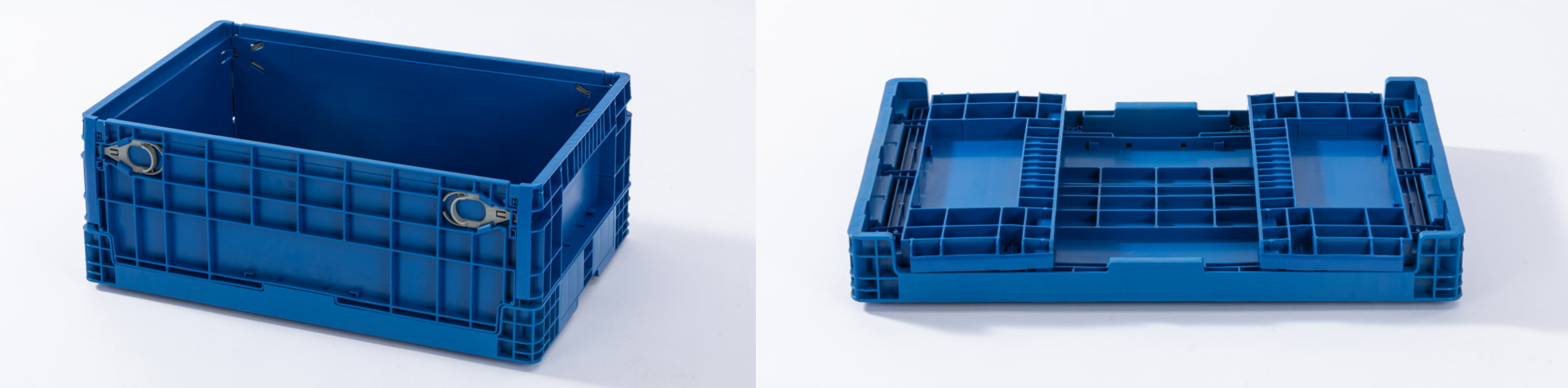
In this project, X-INDUSTECH supported a power battery PACK manufacturer in China with an end-to-end export supply chain program, moving components from Fujian, China to a North American PACK facility. The key to success was not an overly complex custom container—it was a disciplined choice: standardized, automotive-grade foldable KLT containers paired with a packaging lifecycle plan that eliminated expensive return logistics.
The Challenge: Export Packaging That Doesn’t Create a Reverse-Logistics Problem
Export programs typically focus on outbound freight, but experienced supply chain teams know that the total cost picture includes what happens next:
- Packaging accumulates at the destination plant
- Returning empties across borders can require additional freight, coordination, and administrative steps
- If packaging ownership is unclear, assets get lost, damaged, or stranded in the wrong locations
- One-way packaging creates recurring purchasing and disposal cost
The customer needed a packaging model that improved delivery quality and efficiency, but also avoided long-term cost traps.
The Solution: Industry-Standard Foldable KLT as the Packaging Backbone
Instead of treating packaging as a custom “one-off,” X-INDUSTECH selected standardized foldable KLT containers, widely used across the automotive supply chain for their dimensional consistency, stack stability, and handling efficiency.
VDA KLT systems are built around standardized container formats designed for repeatable material flow, smooth handling, and broad compatibility across suppliers and plants. (Source: VDA KLT standard overview, VDA 4500)
By using standardized KLT, the program immediately gained:
1) Fast deployment with predictable performance
Standard formats reduce variability and simplify implementation across shipping, warehousing, and plant receiving.
2) Better loading efficiency and more stable transport units
Uniform footprints and stackability support compact pallet loads and consistent handling—critical for international lanes.
3) Compatibility with modern operations
Standardized containers are easier to integrate with automated and semi-automated handling processes, reducing exceptions and manual work.
The Key Advantage: A “Lease-to-Export” Model That Avoids Buying Packaging
Here’s where the program became truly cost-efficient.
Instead of requiring the customer to purchase a large fleet of KLT containers for export, X-INDUSTECH structured the solution so the customer could lease the packaging only for the export cycle.
This matters because packaging ownership often creates hidden burdens:
- Capital tied up in packaging assets
- Fleet balancing across regions
- Loss and damage responsibility
- Long-term return and repositioning cost
With leasing, the customer gets the operational benefits of standardized KLT without the asset-management headache—and without a large upfront investment.
What Happens After Delivery: Strong Local Channels for Used KLT Redeployment
A major driver of savings came from what happened after parts were delivered in North America.
Because KLT is an automotive industry standard, there is ongoing demand for these containers locally. X-INDUSTECH has strong on-the-ground channels to connect with the North American used-container market and redeploy KLT that is “used / nearly new” into local industrial demand.
This creates a powerful system advantage:
- No empty return transportation back to China
- No additional cross-border return processes
- No idle packaging inventory sitting at the destination plant
- Lower total packaging cost for the customer, because they lease for the export cycle instead of buying the fleet outright
In other words, the packaging lifecycle is completed locally—keeping assets close to demand and converting what would have been reverse-logistics cost into value.
From a material-efficiency perspective, this approach aligns with the widely used waste management hierarchy where reuse is prioritized whenever practical. (Source: U.S. EPA materials management hierarchy)
Results: Higher Efficiency, Lower Total Cost, Smoother Supply Chain Flow
By standardizing on foldable KLT and managing the lifecycle through leasing + local redeployment, the customer achieved:
- Improved delivery quality through stable, standardized packaging
- Higher operational efficiency at shipping, receiving, and plant handling points
- Lower total packaging cost by avoiding purchasing and avoiding return logistics
- Less complexity and risk, because packaging management was handled by an experienced partner
- A scalable model that can expand to new parts, lanes, and sites without reinventing the system
Why This Works: Standardization + Execution + Local Market Capability
Many suppliers can sell packaging. Fewer can design a packaging system that includes:
- choosing the right industry standard,
- executing reliably across an export program,
- and closing the loop through strong local redeployment channels.
That is what X-INDUSTECH delivered here: a standardized KLT strategy that improved efficiency while reducing total packaging cost—without burdening the customer with ownership, return logistics, or idle assets.
Comment