Turning Battery Packaging into a Digital Control Point
Mar 18,2026 | X-INDUSTECH
In battery supply chains, inventory is rarely the problem on paper. The real problem is visibility.
A company may know how much inventory it owns in total, yet still struggle to answer the questions that matter most in daily operations:
Where exactly is it? Which inventory is moving, which is idle, and which is at risk? How much packaging is still circulating? How much stock is truly available for production, shipment, or redeployment?
That gap between “book inventory” and “operational inventory” is where cost, inefficiency, and cash-flow pressure begin.
For one of China’s leading new energy battery companies, X-INDUSTECH helped close that gap by combining reusable cell packaging with a digital IoT-enabled visibility system—creating a more transparent, more controllable, and ultimately more efficient supply chain.
The Challenge: Inventory That Exists, But Cannot Be Clearly Seen
Battery cell supply chains are complex by nature. Packaging circulates continuously between plants, warehouses, and logistics nodes. Inventory is both static and dynamic:
- static inventory sitting in warehouses or plant storage areas
- dynamic inventory moving through transport, staging, transfer, and return loops
- packaging assets that carry the product, but are themselves circulating assets
In many companies, these flows are still managed through fragmented systems, manual scanning, delayed updates, or isolated spreadsheets. The result is familiar:
- unclear stock positions
- poor visibility into packaging circulation
- slow response to shortages or imbalances
- excess safety stock
- working capital tied up in inventory that could be better optimized
Inventory visibility is widely recognized as a core requirement for effective inventory management; IBM notes that businesses need an accurate view of inventory across the supply chain to reduce shipment turnaround times, minimize stockouts, and improve fulfillment performance.
For manufacturers with high-value battery products, this is not just an operational issue. It is a financial one.
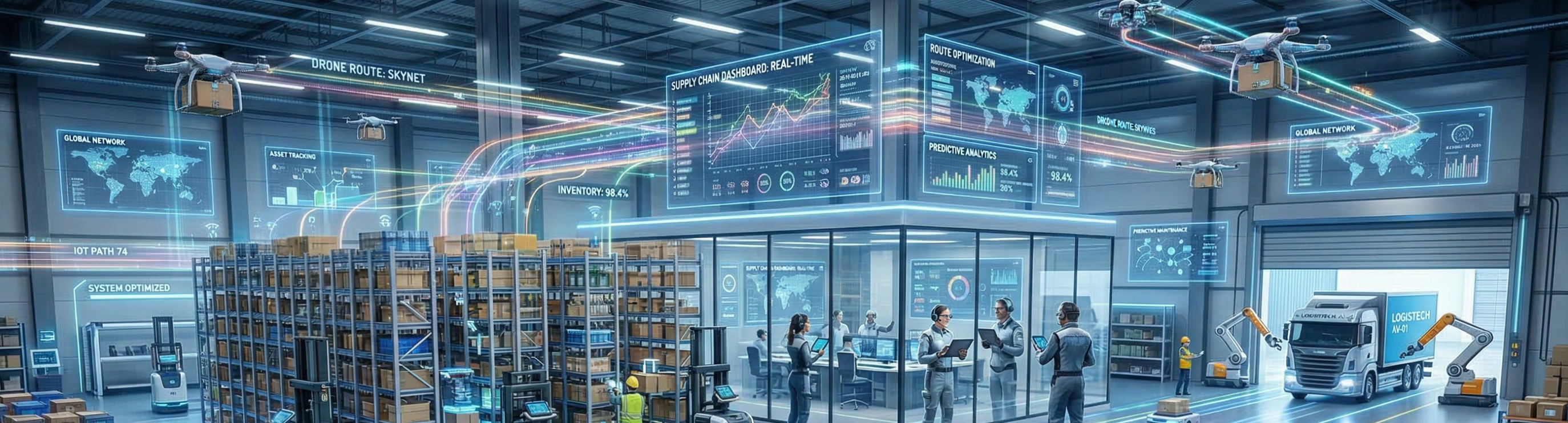
The Solution: Smart Packaging as the Front End, Data Intelligence as the Brain
X-INDUSTECH provided not only the circulating packaging solution for battery cells, but also a digital and intelligent service layer built around that packaging.
The solution had two major components:
1) Hardware: IoT Devices Embedded into the Packaging Network
On the hardware side, X-INDUSTECH deployed:
- self-developed IoT smart chips installed on packaging
- gateways and site devices installed in factories and warehouses
These devices function as the system’s “eyes and hands.” They allow the supply chain to capture packaging and inventory movement continuously—rather than waiting for manual updates or delayed reconciliation.
In practical terms, this means that packaging is no longer passive. It becomes a trackable operational asset, capable of reporting where it is, when it moved, and how it is flowing through the network.
Deloitte has highlighted that smart sensors and IoT-enabled supply chains can improve asset efficiency, lower operating cost, and create digital insight that supports better operational decisions.
2) Software: A Self-Developed Supply Chain Data Platform
If hardware is the sensing layer, software is the decision layer.
X-INDUSTECH’s self-developed supply chain data platform acts as the “brain” of the system. It classifies, stores, processes, and analyzes the data captured through the IoT hardware. More importantly, it turns raw movement signals into usable business intelligence.
By combining this data foundation with AI-enabled analysis, the platform can help users:
- understand real-time inventory distribution
- distinguish static stock from in-transit stock
- identify slow-moving or idle packaging assets
- detect structural imbalances in inventory and packaging pools
- support better replenishment and redeployment decisions
This reflects a broader supply chain trend: McKinsey has noted that digital control towers and connected supply chain systems enable greater transparency, lower inventory, and faster decision-making across the end-to-end network.
What Changed: Inventory Transparency Became Operational Reality
This project was not about adding technology for its own sake. It was about making inventory transparency operationally real.
By attaching intelligence to the packaging that was already circulating through the supply chain, X-INDUSTECH enabled the customer to see both:
- dynamic inventory moving across logistics and factory nodes
- static inventory sitting in storage or waiting for use
That matters because the most valuable operational decisions depend on both.
A company may have enough total inventory in theory—but if too much is in the wrong place, moving too slowly, or trapped in low-visibility loops, the business still behaves as if inventory is short.
With transparent, near-real-time visibility, the customer could begin to manage inventory with far greater confidence:
- reducing uncertainty
- improving response speed
- making more accurate deployment decisions
- lowering the need for excessive safety stock
Why This Matters Financially: Better Visibility Improves Cash Flow
Inventory is not just an operational asset. It is a cash-flow issue.
The less transparent inventory becomes, the more likely companies are to compensate by adding buffers, holding extra stock, and over-positioning materials “just in case.” That may feel safe operationally, but financially it increases working capital pressure.
By improving visibility through smart packaging and digital analysis, the customer gains the ability to make better inventory decisions with less guesswork. That makes it possible to:
- reduce overall inventory levels
- raise turnover efficiency
- lower idle stock
- improve packaging asset utilization
- release working capital tied up in excess inventory
McKinsey has similarly noted that connected, digital supply chain ecosystems can enable lower inventory and improved performance by removing silos and improving real-time visibility.
In other words, inventory transparency is not just about “seeing better.” It is about operating leaner and protecting cash flow.
Why Packaging Was the Right Control Point
One of the most important design choices in this project was to use the packaging itself as the visibility carrier.
That is strategically powerful for three reasons:
Packaging is already moving through the entire supply chain
Unlike many standalone tracking approaches, packaging naturally travels through suppliers, warehouses, logistics nodes, and plants. It is already present at the physical touchpoints that matter most.
Packaging connects product flow and asset flow
Battery cell packaging is not just a container. It is both:
- a protection medium for the product
- a reusable asset circulating through the supply chain
By digitizing packaging, the customer gains visibility into both product movement and packaging utilization at the same time.
Packaging creates a scalable data layer
Once packaging becomes “smart,” the visibility model can scale across:
- additional SKUs
- more plants and warehouses
- broader reusable packaging loops
- future AI-based optimization use cases
That makes packaging not just a logistics item, but a digital control point for the supply chain.
A Broader Lesson for Modern Manufacturing Supply Chains
This case reflects a larger reality in advanced manufacturing: companies do not need more disconnected dashboards. They need better operational sensing and better decision infrastructure.
IoT hardware without analytics creates data noise.
Analytics without real-time operational inputs creates blind spots.
But when reusable packaging, sensing hardware, and a supply chain data platform are built as one system, visibility becomes actionable.
That is where real efficiency gains begin.
X-INDUSTECH: Packaging, IoT, and Supply Chain Intelligence in One System
X-INDUSTECH is more than a packaging supplier. We combine reusable industrial packaging, IoT-enabled hardware, and digital supply chain intelligence to help customers improve visibility, efficiency, and asset utilization across complex manufacturing networks.
For customers in battery, automotive, and advanced manufacturing supply chains, we can provide:
- reusable plastic packaging solutions
- standard and custom packaging engineering
- IoT smart chips and gateway deployment
- digital supply chain data platforms
- lifecycle services across circulation, maintenance, and packaging management
Our goal is not simply to make packaging smarter. It is to help customers make better decisions—faster, with greater visibility, and with stronger control over inventory, operations, and cash flow.
In a supply chain where every unit of inventory affects both service and capital, that kind of transparency is no longer optional. It is a competitive advantage.
Comment