Precision Inside the Package
Apr 07,2026 | X-INDUSTECH
For automotive parts suppliers, packaging is never just about outer boxes. In many cases, the real performance difference is created inside the package.
Small, high-value components can still create major supply chain risk if they shift, rub, deform, or become difficult to handle during transport and storage. That is why more manufacturers are paying closer attention to custom dunnage—the engineered inner packaging that protects parts, stabilizes loading, and helps standardize handling across logistics and warehousing operations.
In this case, X-INDUSTECH supported an automotive parts manufacturer in China by designing and validating custom packaging inserts for its parts program. The result was not only more stable packaging performance, but also stronger delivery consistency and nearly 15% lower total supply chain cost.
The Challenge: Protection, Handling, and Cost Needed to Improve at the Same Time
The customer needed inner packaging that could do more than simply “hold parts in place.” The packaging had to work across real operating conditions—transport, warehousing, stacking, loading, unloading, and line-side handling—without creating extra friction for operators.
Like many industrial packaging projects, the challenge was multi-variable:
- part protection had to improve,
- inner packaging had to be durable enough for repeated or demanding use,
- weight needed to come down where possible,
- and handling needed to become easier and more efficient.
In other words, the customer was not looking for a packaging material. They were looking for a better packaging system.
The Solution: Engineered Dunnage Across Multiple Material Paths
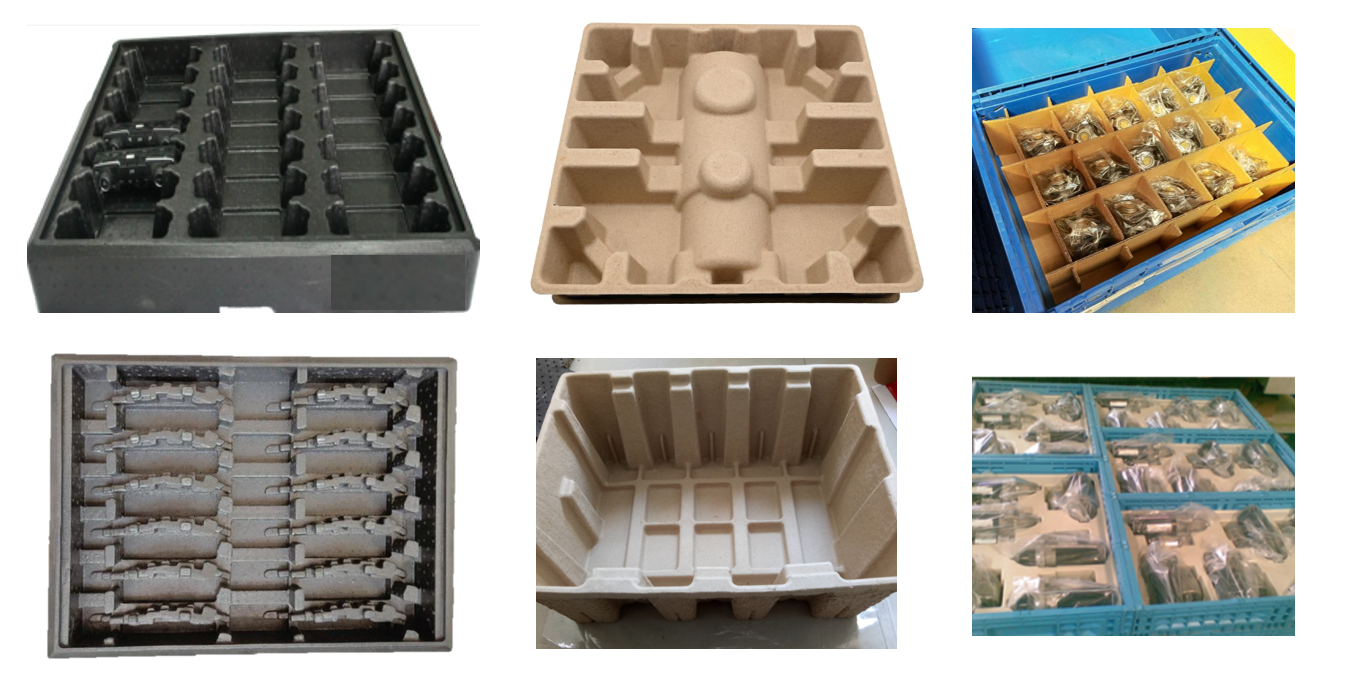
X-INDUSTECH provided the customer with custom-designed packaging inserts tailored to part geometry, logistics flow, and target cost structure.
Depending on the application, the solution could use:
- heavy-duty paper-based disposable dunnage for one-way or lower-cycle programs,
- EPP (expanded polypropylene) for lightweight, durable, reusable applications,
- or EPS (expanded polystyrene) where molded cushioning and shock protection were required.
This material flexibility mattered. It allowed the packaging strategy to be built around actual operating requirements instead of forcing every program into a single material path.
From an engineering perspective, these materials serve different roles in protective packaging. Industry guidance notes that custom-molded EPS is widely used for shock absorption and product protection in demanding shipping environments, while reusable plastic packaging materials such as EPP are valued for being lightweight, durable, and water-resistant.
Design Priorities: Protection, Durability, Ease of Use, and Weight Reduction
X-INDUSTECH’s design team approached the project with four priorities in mind.
1) Stronger part protection
The insert had to control part movement, reduce contact risk, and protect product condition through transport and storage.
2) Higher durability
Whether the insert was disposable or reusable, it had to withstand the real distribution environment without early degradation.
3) Better operator usability
Good packaging should not slow people down. The inserts were engineered to support easier loading, unloading, picking, and handling in day-to-day operations.
4) Lower packaging weight
Reducing dunnage weight where feasible helps reduce freight burden and improve handling efficiency. Over large shipment volumes, even small weight reductions can create meaningful logistics and warehousing savings.
These priorities reflect a broader best practice in packaging engineering: optimize not only for product protection, but also for handling efficiency and total system cost.
Validation Matters: Testing for Real Distribution Conditions
One of the most important parts of the project was not just design—it was testing.
X-INDUSTECH used professional packaging test equipment to evaluate whether the packaging system could meet the customer’s real transport and storage requirements. This is critical because packaging performance should be judged against the actual distribution environment, not just visual fit.
That approach aligns with established industry practice. ASTM D4169 is a foundational standard for evaluating shipping units against hazards likely to occur in real distribution cycles, and ISTA’s transit testing procedures are widely used to compare and validate package performance in transport environments.
By validating performance before scale-up, the project reduced downstream risk and improved confidence that the packaging would perform consistently across the customer’s logistics and warehousing scenarios.
The Business Result: More Stable Delivery, Lower Total Cost
With the optimized dunnage design in place, the customer gained a more reliable packaging solution across its supply chain.
The improvements were visible in several areas:
- more stable product delivery quality,
- better consistency across logistics and warehousing processes,
- easier handling in daily operations,
- lower damage risk,
- and reduced cost across storage and transportation.
Most importantly, the project helped the customer reduce total supply chain cost by nearly 15%.
That result did not come from material cost alone. It came from system-level optimization:
- lighter and more efficient inserts,
- better protection,
- less operational friction,
- and packaging designed to work across all relevant handling scenarios.
Why Custom Dunnage Often Delivers Outsized Value
Outer packaging usually gets the attention. But in many industrial programs, the insert is where the value is won or lost.
Custom dunnage can improve:
- pack density,
- part protection,
- ease of loading,
- handling speed,
- repeatability,
- and labor efficiency.
For automotive and precision-manufacturing supply chains, those gains are often more meaningful than small savings on material price alone.
This case illustrates a simple truth: when inner packaging is engineered well, the entire supply chain becomes more stable.
X-INDUSTECH: From Material Selection to Tested Performance
X-INDUSTECH supports customers with both disposable and reusable custom dunnage solutions, backed by experienced packaging engineers and real test capability.
Whether the application calls for heavy-duty paper-based inserts, EPP, EPS, or another fit-for-purpose structure, our focus remains the same:
- protect the product,
- improve usability,
- reduce unnecessary weight,
- validate performance,
- and lower total operating cost.
For manufacturers that want packaging to do more than “contain,” X-INDUSTECH helps turn packaging inserts into a measurable supply chain advantage.
Comment