Packaging Is Not a Detail: Understanding Supply Chain Cost Structure and Why Packaging Deserves Strategic Attention
Feb 02,2026 | X-INDUSTECH
In an increasingly complex global environment, supply chain cost control has become a defining factor for competitiveness. Rising transportation costs, inventory pressure, labor constraints, and trade complexity force manufacturers and supply chain leaders to re-examine where money is truly being spent—and where efficiency can be gained.
To manage costs effectively, it is critical to understand the structure of total supply chain costs and the role each component plays.
Breaking Down the Supply Chain Cost Structure
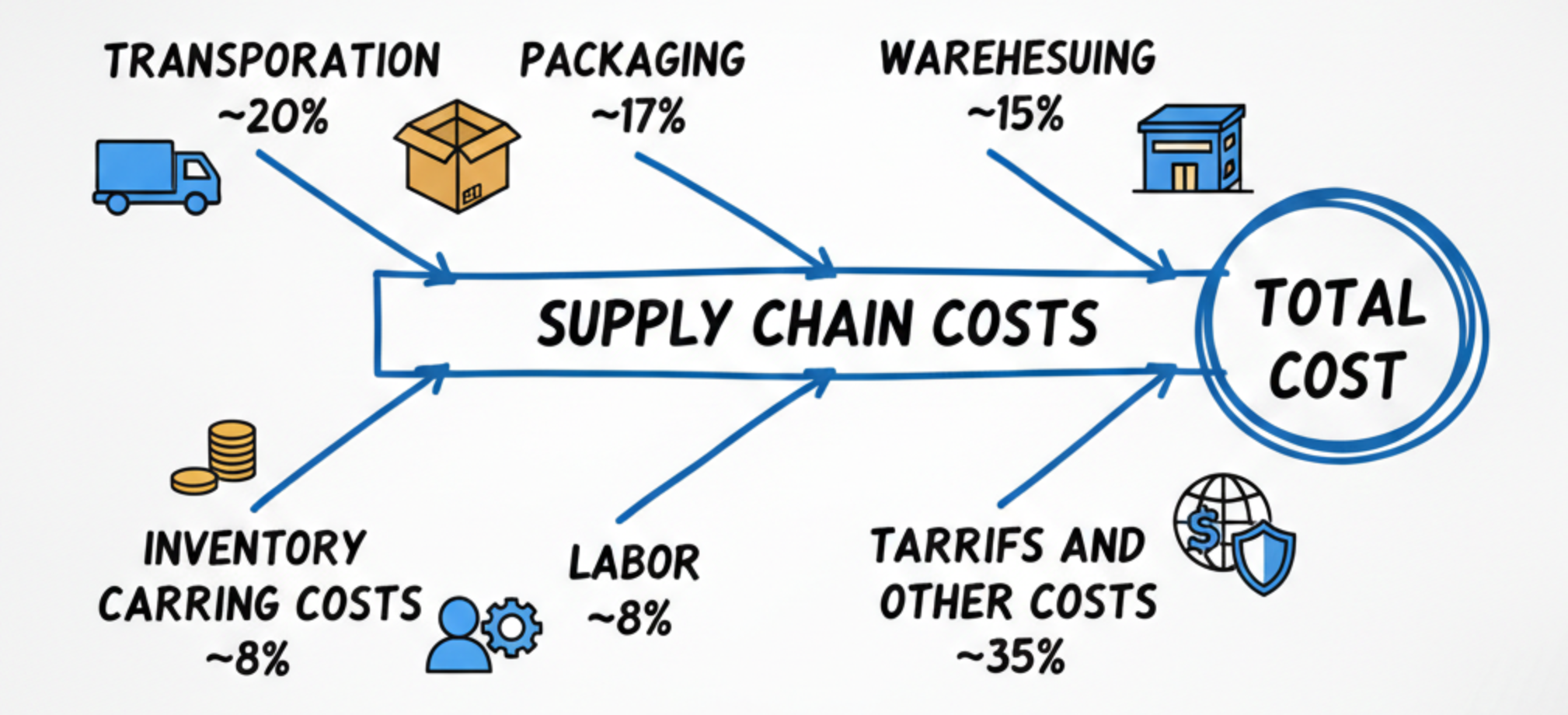
In a typical industrial supply chain, total costs are commonly distributed across the following categories:
- Transportation – ~20%
Freight, fuel, and cross-border transportation costs that directly impact landed cost. - Inventory Carrying Costs – ~8%
Capital tied up in inventory, including financing, insurance, and obsolescence risk. - Packaging – ~17%
Packaging materials, handling, protection, circulation, and system-related costs. - Warehousing – ~15%
Facility operations, storage space, equipment, and internal handling. - Labor – ~8%
Manual handling, packing, sorting, and operational workforce costs. - Tariffs and Other Costs – ~35%
Duties, compliance costs, taxes, and other indirect supply chain expenses.
While transportation and tariffs often receive the most attention, packaging represents one of the largest controllable cost categories in the supply chain—and one with outsized influence on overall performance.
Packaging: A Cost Category with System-Wide Impact
At approximately 17% of total supply chain cost, packaging is far more than a line item. It directly affects transportation efficiency, warehouse utilization, labor productivity, inventory stability, and even damage rates.
Poorly designed packaging can increase costs across multiple categories at once:
- Inefficient cube utilization drives up transportation spend
- Weak protection increases damage and rework
- Incompatible designs slow down automation and handling
- Single-use packaging creates recurring procurement and disposal costs
Conversely, well-engineered packaging creates leverage across the entire supply chain.
Why Packaging Is a Strategic Lever—not Just an Expense
Packaging touches every physical movement of goods. When designed correctly, it can:
- Increase load density and reduce freight cost per unit
- Improve stacking and space utilization in warehouses
- Support automated handling, palletizing, and storage systems
- Reduce manual handling time and labor dependency
- Stabilize inventory flows across suppliers, warehouses, and plants
This is why experienced supply chain teams no longer treat packaging as a purchasing afterthought—but as a core operational asset.
Choosing the Right Packaging Partner Matters
To unlock the full value of packaging, manufacturers need partners who understand not only containers—but real-world supply chain operations.
X-INDUSTECH supports customers across the full packaging lifecycle, including:
- Custom-engineered plastic containers tailored to product, logistics, and automation requirements
- Standardized plastic container sales, based on international industry standards
- Plastic container leasing programs, supporting JIT supply, circulation, cleaning, and maintenance
- Used container programs, offering cost-efficient alternatives with verified performance
- Recycling and maintenance services, helping customers manage packaging assets over time
By combining design & R&D capability, tooling expertise, scalable manufacturing, and operational services, X-INDUSTECH helps customers optimize packaging not in isolation—but as part of the entire supply chain system.
Packaging as a Competitive Advantage
When packaging is approached strategically, its impact extends well beyond the 17% cost category it occupies. It becomes a driver of efficiency across transportation, warehousing, labor, and inventory—and a stabilizing force in complex, global supply chains.
For manufacturers and supply chain leaders looking to control cost, improve resilience, and scale efficiently, investing in the right packaging strategy is no longer optional—it is essential.
Comment