Packaging Performance Gets You Started. Daily Operations Make Reusables Work.
Mar 26,2026 | X-INDUSTECH
When companies evaluate reusable packaging, they usually start with the container itself: load capacity, stackability, material strength, automation compatibility, and part protection. Those are all essential. But in real supply chains, container performance alone does not guarantee results.
A reusable packaging program succeeds or fails in daily operations.
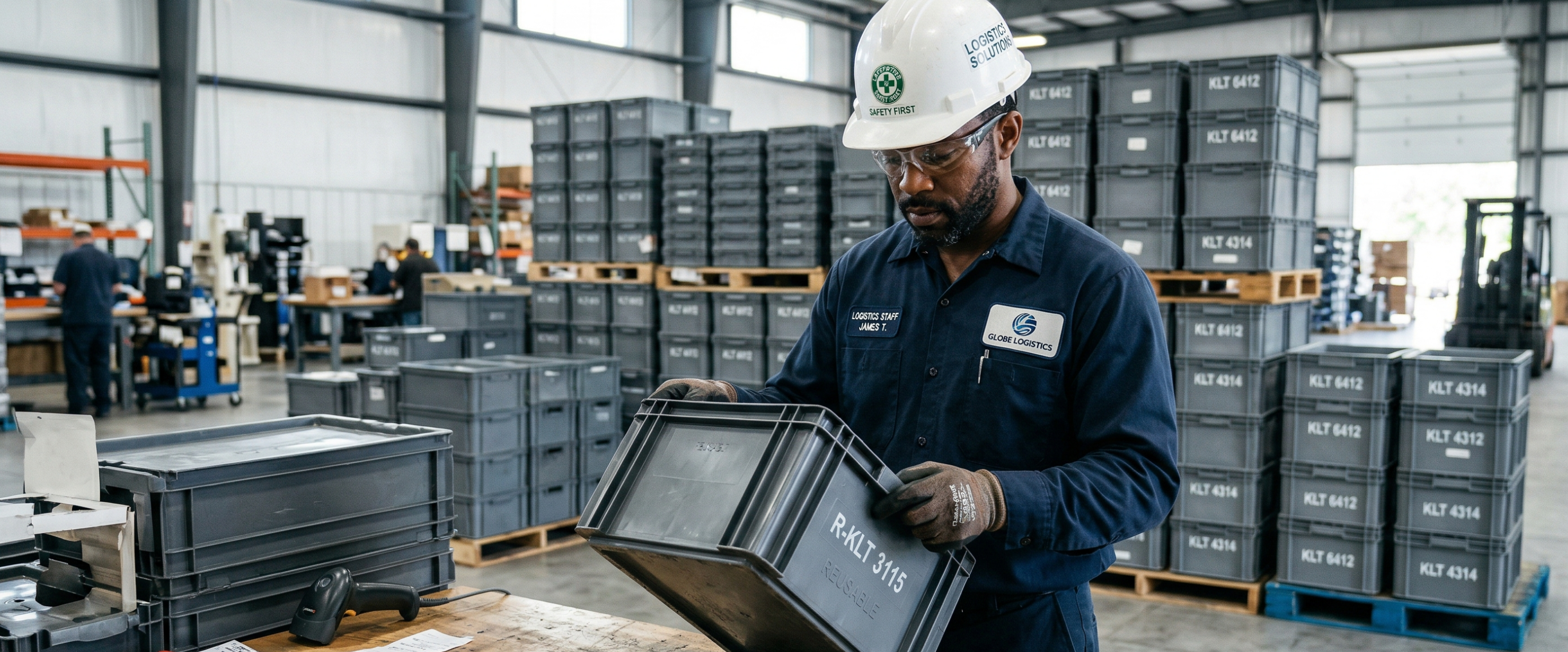
If containers are not cleaned on time, inspected consistently, repaired quickly, and redeployed efficiently, even the best-designed packaging system will begin to underperform. Dirt builds up. Damage goes unnoticed. Labels become unreadable. Inventory visibility weakens. Eventually, supply chain efficiency suffers.
That is why leading manufacturers increasingly recognize a simple truth: daily operations management for reusable packaging is just as important as packaging performance itself.
Reusable Packaging Is Not a Product. It Is an Operating System.
Single-use packaging ends its job after one trip. Reusable packaging does not.
Reusable containers, KLTs, foldable boxes, pallet boxes, and racks are part of a continuous circulation loop. That loop includes outbound shipment, receiving, storage, line-side use, empty return, cleaning, inspection, maintenance, redistribution, and redeployment. The SCOR framework explicitly includes the return of reusable packaging such as pallets and containers as part of supply chain return management, underscoring that reusable assets must be managed as an operational process, not just procured as materials.
In other words, reusable packaging is not simply a packaging decision. It is a supply chain operations discipline.
Clean Packaging Helps Protect Product Quality
For many industrial applications, packaging cleanliness is not a cosmetic issue. It is directly tied to product quality and process stability.
Dust, residue, moisture, oil carryover, and worn labels can all create risk—especially where parts are precision-machined, surface-sensitive, coated, or destined for automated handling environments. If reusable packaging is not properly cleaned and sanitized between cycles, contamination risk increases and quality stability declines.
This is not just best practice—it is recognized in formal standards. ISO/TS 22984:2021 provides guidelines for cleaning and sanitation procedures for reusable transport packaging, reflecting the importance of maintaining reusable packaging in a controlled and repeatable way.
The implication for manufacturers is clear: a reusable packaging fleet must remain consistently clean and operationally ready, not just structurally intact.
Inspection and Repair Protect Both Packaging Assets and Supply Chain Stability
Reusable packaging degrades over time. Hinges loosen. Latches fail. Walls crack. Bases warp. Interior protection wears out. If that damage is not detected and addressed early, the result is more than just a bad box.
It can lead to:
- part damage in transit
- unstable stacking
- conveyor and automation issues
- slower manual handling
- line-side disruptions
- emergency packaging shortages
Well-run daily operations prevent these risks through standard inspection and maintenance routines. Containers are checked, sorted, repaired, or removed from circulation before they become operational failures.
This is one reason why professional reusable packaging programs rely on trained personnel, defined work instructions, and clear condition standards—not ad hoc warehouse judgment.
Good Operations Increase Packaging Pool Utilization
Many companies think they have a packaging shortage when they really have a packaging management problem.
Containers often exist in the network, but they may be:
- sitting idle at the wrong site
- delayed in return loops
- waiting to be cleaned
- not yet repaired
- physically available but not usable
That is where daily operational discipline has a direct financial impact.
When cleaning, inspection, maintenance, and redeployment are managed efficiently, the same packaging pool can support more trips, more throughput, and more stable service levels. SAP’s returnable packaging management guidance emphasizes real-time tracking of shipments and receipts to reduce loss, waste, and damage while optimizing logistics cost.
In practice, better daily management means:
- fewer emergency purchases
- lower idle inventory
- higher asset turns
- better availability at the plant
- lower total packaging cost per cycle
That is operational efficiency converting directly into cost savings.
Better Operations Mean Better Visibility
Daily operations are also what make packaging inventory visible and controllable.
A reusable packaging system should not operate on assumptions. It should be managed through facts:
- how many containers are clean and ready
- how many are in repair
- how many are in transit
- how many are sitting too long at one node
- how many are missing, damaged, or underutilized
Without disciplined operational management, reusable packaging becomes difficult to measure. Without measurement, it becomes difficult to improve.
That is why strong reusable programs track operational KPIs such as:
- cycle time per loop
- cleaning turnaround time
- repair rate
- damage rate
- loss rate
- empty availability by site
- usable vs. non-usable inventory status
Visibility begins in the field, not in the dashboard.
Cleaning and Maintenance Need Standardization, Not Improvisation
One of the biggest mistakes in reusable packaging programs is assuming that washing, repair, and upkeep can be handled informally.
In reality, high-performing systems rely on:
- standardized cleaning procedures
- clear inspection criteria
- defined repair methods
- traceable disposition rules
- trained personnel and accountable workflows
The Reusable Packaging Association’s best-practice guidance stresses disciplined wash operations, Good Manufacturing Practice-style controls, and alignment across supply chain participants to ensure reusable packaging remains safe and fit for service.
This matters far beyond food or highly regulated sectors. In any industrial environment, lack of standardization creates variability. And variability is the enemy of efficiency.
Daily Operations Matter Even More in Automated Supply Chains
As supply chains become more automated, packaging quality and readiness become even more critical.
Automation depends on repeatability. If containers are dirty, damaged, deformed, or incorrectly labeled, they can create:
- scan failures
- conveyor jams
- robotic pick errors
- palletizing instability
- manual overrides and downtime
A reusable packaging fleet that is not professionally maintained can quietly undermine automation performance—even if the original container design was excellent.
That is why daily packaging operations should be viewed as part of the broader automation-readiness strategy.
The Real Lesson: Performance on Paper Is Not Enough
A container may perform well in design validation, lab testing, or pilot runs. But in the real world, long-term performance depends on what happens between cycles.
That includes:
- cleaning
- inspection
- repair
- preventive maintenance
- inventory balancing
- quality control
- redeployment discipline
The reusable packaging programs that deliver the strongest results are not necessarily the ones with the most sophisticated container design. They are the ones with the most disciplined operating model.
Why the Right Packaging Partner Matters
For manufacturers, this is where partner selection becomes critical.
Whether a company chooses to buy reusable packaging or lease it, the right supplier should not only provide strong packaging products. It should also be able to support—or fully operate—the system that keeps those assets working every day.
A strong packaging partner helps customers:
- keep packaging clean and production-ready
- reduce loss and damage
- maintain stable supply to plants and warehouses
- improve asset turns and inventory control
- lower operational friction and hidden cost
That is exactly where X-INDUSTECH creates value.
X-INDUSTECH provides not only custom and standard plastic packaging solutions, but also the operational support that makes reusable systems sustainable at scale. Our capabilities include packaging design, standardized container supply, leasing, maintenance, cleaning, repair, recycling, used-container programs, and broader packaging lifecycle management. For customers running reusable packaging across industrial, warehousing, and logistics environments, we help turn packaging from a passive asset into a reliable, managed system.
Because in the end, reusable packaging does not create value simply by existing. It creates value when it is clean, maintained, visible, and always ready for the next cycle.
Comment